Product Description
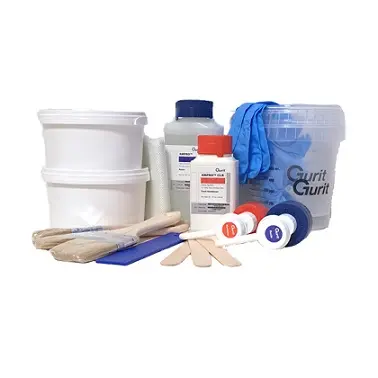
EPOXY REPAIR KIT
Package includes:
- • Ampro Clear Epoxy (Fast Hardener) – 0.375 kg
- • 5 ml Pump for Resin
- • 5 ml Pump for Hardener
- • Fiberglass Tape 160 g/m², 100 mm × 2 m
- • Cellulose Fiber Filler, 0.4 L
- • White Microballoons, 0.4 L
- • Mixing Cup 500 ml x 2 pcs
- • Protective Gloves, Size L x 3 pairs
- • Mixing Stick x 3 pcs
- • Brush 25 mm x 2 pcs
- • Brush 50 mm x 1 pcs
The versatile Ampro Epoxy Resin is an easy-to-use, multi-purpose epoxy system suitable for a wide range of applications. It can be used as-is for laminating reinforcements, as a primer, or as a wood coating. When fillers are added, the resin becomes an excellent adhesive or filler compound. By choosing either the fast or slow hardener, you can adjust the working time and adapt to different environmental conditions. Ampro is a traditional epoxy resin with decades of proven performance, especially in the construction and repair of wooden boats, but also for fiberglass boat repairs. It works perfectly with lightweight reinforcements up to approx. 300 g/m².
Mixing ratio by volume 5 : 1 and by the weight 100 : 18
Pot Life at 20°C 150g: 30 min
Working time at 20°C: 140 min
Epoksin määrä, annostelu
The required amount of epoxy resin is typically 1.5–2 × the weight of the fabric (including waste). For example, when using 200 g/m² fabric, about 300–400 g/m² of resin is needed for proper wet-out. Always follow the specified mixing ratio – too much or too little hardener will prevent proper curing. A precise scale (protected in a clear plastic bag) is the best tool for accurate dosing. Medical syringes are excellent for measuring small quantities of resin and hardener (use separate syringes for each). Once both resin and hardener have been measured into a mixing cup, mix thoroughly – scrape the bottom and sides of the container carefully. Epoxy will not cure properly if the ratio is incorrect, the mixture is uneven, or the temperature is too low.
Working Instructions
Always apply resin first, then lay the fiberglass mat on top. Start laminating with the largest piece of fiberglass (resin underneath, fabric on top). No air should remain under the mat – remove air either by using an aluminum roller, tapping gently with a brush, or squeegeeing with a rubber spatula. For small repairs, a brush is sufficient. For larger laminations (over 1 m²), use both a wet-out roller and a brush, finishing with an air-release roller. Subsequent layers can be laminated immediately, from largest to smallest. If you must work upward (from below), allow the first layer to cure before applying additional ones.
Temperature Conditions
Best results are achieved at around +20°C. When the repair temperature is close to +15°C, always use the fast hardener. Below +15°C, proper curing cannot be guaranteed. High air humidity can also affect curing negatively — humidity should be below 70%. Adding more hardener will not speed up curing; always use the correct ratio. For cold conditions: Keep the resin and hardener warm (you can preheat them to approx. +30°C). Use a heat blower or take advantage of sunlight to warm the work area. Maintain additional heat during the entire curing period. Always refer to the temperature of the work surface, not just the ambient air. For example, even if the air temperature is +20°C, curing will be slow if the repair surface is only +15°C (e.g. a cold boat hull or concrete floor).
Safety Instructions

Before working with epoxy, always ensure good ventilation and skin protection. Wear long sleeves and disposable gloves resistant to epoxy (e.g. nitrile gloves). Uncured epoxy resin is a strong skin sensitizer. Fully cured epoxy is non-toxic and safe to handle.
Hazard Statements
Resin component:
H302 – Harmful if swallowed; H315 – Causes skin irritation; H317 – May cause an allergic skin reaction; H319 – Causes serious eye irritation; H351 – Suspected of causing cancer; H373 – May cause damage to organs through prolonged or repeated exposure; H411 – Toxic to aquatic life with long-lasting effects
Hardener component:
H302 – Harmful if swallowed; H311 – Toxic in contact with skin; H314 – Causes severe skin burns and eye damage; H317 – May cause an allergic skin reaction; H336 – May cause drowsiness or dizziness; H341 – Suspected of causing genetic defects; H361 – Suspected of damaging fertility or the unborn child; H412 – Harmful to aquatic life with long-lasting effects
Tools can be cleaned with acetone, but remember — epoxy is an excellent adhesive and bonds to almost anything, including your tools. Therefore, it’s best to use inexpensive disposable tools that can be discarded after use.