Product Description
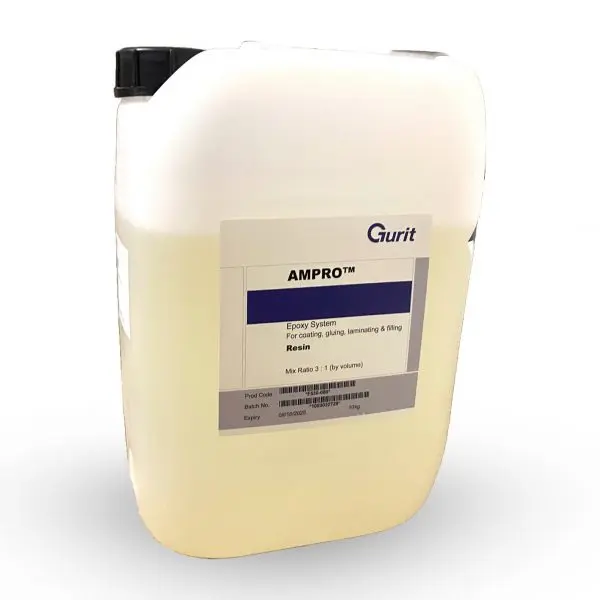
EPOXY AMPRO RESIN 10 KG
AMPRO™ is a solvent-free epoxy resin system developed for boatbuilding, suitable for wood bonding, surface coating, and laminating with fiberglass. It is recommended as a general-purpose epoxy for all types of woodworking and as a coating epoxy for wooden surfaces that will be painted afterwards or do not require a high-gloss finish. The epoxy is also ideal for high-quality, clear, and transparent coatings that enhance the natural beauty of wood. When thickened with microspheres, AMPRO™ can be used as a fairing compound or profiling filler. This resin system can bond not only wood but also composites, metals, and concrete.
As a wood adhesive and surface sealer, AMPRO™ improves the compressive strength of wood fibers and creates a moisture barrier. Compared to untreated wood, surfaces coated with AMPRO™ epoxy stay drier, retain their shape better, and maintain good mechanical properties. Wooden parts to be bonded or otherwise joined can be pre-coated before installation. This saves time, simplifies work, and ensures that the entire wooden part is properly sealed with epoxy. Prior to bonding, the contact surfaces must be roughened. Bonding is done with the AMPRO™ resin system or another Gurit epoxy suitable for wood adhesion.
Three hardeners are available: fast, slow, and extra slow. The extra slow hardener should only be used in exceptionally warm conditions. The mixing ratio of resin to hardener is 3:1 by volume and 100:29 by weight. This specified ratio must be followed. Deviating from it will compromise the final result and will not affect the curing time. The resin system cannot be thinned with solvents.
– Easy to use
– Low hazard
– Solvent-free
– Versatile
– Clear
Working Conditions
The recommended working temperature is 15–25 °C. Cold air and high humidity negatively affect both workability and final results. When the temperature drops below the recommended range, the resin and hardener become thicker. Before use, both components must be preheated to at least 15 °C. All materials that come into contact with the resin system must also be at or above this temperature to prevent the mixed epoxy from cooling below the optimal working temperature. The slow hardener should be used when extended working time is needed or when the temperature is 25 °C or higher. It is also recommended for fairing and profiling applications at temperatures above 21 °C and whenever the thickness of the fairing or profiling layer exceeds 10 mm. The minimum working temperature is 5 °C; however, contact the distributor before using at low temperatures.
Property | Resin | Fast Hardener | Slow hardener |
Mix ratio by volume | 3 | 1 | 1 |
Mix ratio by weight | 100 | 29 | 29 |
Viscosity at 25 °C, cP | 592 | 620 | 250 |
Viscosity at 15 °C, cP | 1708 | 1680 | 570 |
Viscosity at 25 °C, cP mixed | 971 | 760 |
Working Times at 20°C | Fast Hardener | Slow hardener |
Gel time (thin layer formed) | 1h 33min | 2h 21min |
Pot Life (150g) | 30 min | 1h 15min |
Touch-dry time | 2h 45min | 4h |
Ready for sanding | 12h | 16h |
Coverage/Thickness | Resin consumption | Resin consumption depends on temperature, surface angle, porosity, and smoothness. | |
Layer thickness | 250 µm | n. 3 m²/kg | |
Bonding | n. 1,5-2 m²/kg | ||
Ampro™ + 160 g/m² fiberglass | n. 310 g/m² | ||
Ampro™ + 300 g/m² fiberglass | n. 600 g/m² |
The resin and hardener must be thoroughly mixed together. It is most practical to carry out this mixing in a container, mixing only the amount that is appropriate for the job and that can be used without haste. The required amount of epoxy resin is approximately 1.5–2 × the weight of the fabric (including waste). If a 200 g/m² fabric is used, the resin needed for wetting is about 300–400 g/m². Always follow the recommended epoxy dosing ratio – do not add too much or too little hardener.
For dosing, the best tool is a precise scale wrapped in a transparent plastic bag. Medical syringes are an excellent way to measure small amounts of resin and hardener (use a separate syringe for each). Once you have measured the appropriate amounts of resin and hardener into a container, mix thoroughly – always scrape the bottom and sides of the container with a mixing stick. After about a minute of mixing, pour the resin–hardener mixture into a wide working tray. The reaction between resin and hardener produces heat (an exothermic reaction), which shortens pot life and working time. In a wide tray, the temperature rise is significantly lower and has a negligible effect on pot life. Temperature influences working time, gel time, and pot life such that as temperature increases, times shorten—and vice versa. Gel time also decreases with larger batch sizes. The epoxy resin will not cure properly if the mixing ratio is incorrect, the mixing is inadequate, or the temperature is too low.
Always apply resin first, then place the fabric on top. Begin laminating with the largest piece of fiberglass (resin underneath, fabric on top). No air should remain under the fabric. It must be rolled out using an aluminum laminating roller, “tapped” with a brush, or the air drawn out with a rubber squeegee. For small repairs, a brush is sufficient. For larger operations using more than 1 m² of fabric, it is better to use both a wet‑out roller and a brush (and of course finish with an air-removal roller). Subsequent layers of fiberglass cloth can be laminated immediately, from largest to smallest. However, if you must work from bottom to top, it is wise to let the first layer cure before applying the next.
Curing time depends on temperature. As a rule of thumb, curing time is halved for every 10 °C increase. At room temperature, full cure is achieved in 7 days, and at 40–50 °C in about 24 hours. It is important to note that although sufficient strength for most applications is achieved after about 24 hours at room temperature, bonded joints subjected to high loads must be allowed to cure fully before being stressed.
Safety
Before handling epoxies, always ensure good ventilation and skin protection. Wear long-sleeved clothing and disposable gloves that resist epoxy (e.g. nitrile). Uncured epoxy resin is strongly sensitizing to skin. Fully cured epoxy is non‑hazardous to health.
Tools may be cleaned with acetone, but keep in mind that epoxy is a very strong adhesive and will stick to almost anything, including tools. Therefore, use inexpensive tools that can be discarded.
AMPRO™ Epoxy Resin: H315 Causes skin irritation; H317 May cause an allergic skin reaction; H319 Causes serious eye irritation; H411 Toxic to aquatic life with long lasting effects; P272 Contaminated work clothing must not be taken from the workplace; P273 Avoid release to the environment; P302+P352 IF ON SKIN: Wash with plenty of water.
AMPRO™ Slow Hardener: H302 Harmful if swallowed; H314 Causes severe skin burns and eye damage; H317 May cause an allergic skin reaction; H412 Harmful to aquatic life with long lasting effects; P260 Do not breathe vapors; P264 Wash hands thoroughly after handling; P270 Do not eat, drink or smoke when using this chemical; P272 Contaminated work clothing must not be taken from the workplace; P273 Avoid release to the environment; P280 Wear protective gloves, protective clothing, eye protection.