Product Description
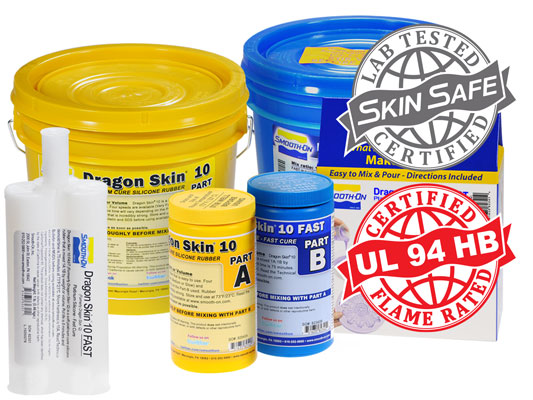
Dragon Skin™ 10 FAST 7,26 KG
Dragon Skin™ 10 FAST is a high-quality platinum-cured two-part silicone designed for applications where an extremely durable and stretchy, yet fast-curing silicone is required.
The Dragon Skin™ series is used for, among other things, special effects, prosthetics, padding, and mold making. Once cured, the material is skin-safe and certified by an independent laboratory.
Properties
- Extremely stretchable and tear-resistant
- Designed for “skin effect” applications
- Fast working and curing time
- Compatible with THI-VEX™ thickener
- Can be tinted with Silc Pig™ pigments
Hardness (ShoreA) | 10A |
Mixing ratio (by volume) | 1A:1B |
Pot life (23 °C) | 8 min |
Curing time (23 °C) | 75 min |
Heat resistance (min) | -53 °C |
Heat resistance (max) | 232 °C |
Shrinkage |
<0,001
mm/mm
|
Viscosity (cpc) | 23 000 |
Tear strength (N/mm)
| 17,9 N/mm |
Tensile strength (N/mm²) | 3,28 MPa |
Elongation (%) | 1000 |
Color | Translucent |
Instructions for use
First, mix both components thoroughly. Measure Part A and Part B at a 1:1 ratio by weight or volume. Mix carefully, scraping the sides and bottom of the container until the color is completely uniform.
Removing air bubbles: For best results, vacuum degas the mixture after mixing. You will need a pump capable of pulling at least 1 bar of vacuum. Leave enough headspace in the container for the silicone to expand (it can expand several times its volume) — it will rise, break, and then collapse. Continue degassing for one minute after the surface has leveled out.
Pour the silicone slowly into the lowest point of the mold and continue until the desired level is reached.
Allow the mold to cure at room temperature (23 °C) for the specified time. Do not cure below 18 °C — the reaction may slow down significantly or stop completely. If desired, the mold can be post-cured (optional): 80 °C / 2 hours or 100 °C / 1 hour. Let the mold cool to room temperature before use.
Cure inhibition: Certain materials can inhibit the cure of addition-cure silicones, such as latex, tin-cured silicones, sulfur-containing clays, certain wood surfaces, fresh polyester castings, epoxy products, and polyurethane products. If compatibility is uncertain, perform a small test cast. Inhibition occurs if the silicone remains tacky or does not cure. Sealing the model with a clear acrylic lacquer can help prevent inhibition issues. Allow the lacquer to dry completely before applying silicone. Note: Platinum silicone does not work with clays that contain high amounts of sulfur.
Safety
Use in a well-ventilated area. Safety glasses, long-sleeved clothing, and vinyl gloves only are recommended—latex gloves can inhibit the silicone from curing.
We recommend doing a small patch test on the back of your hand to check for possible allergic reactions. If your skin reacts, do not use the product. For external use only — do not ingest and do not use for making molds intended for use inside the mouth.