Product Description
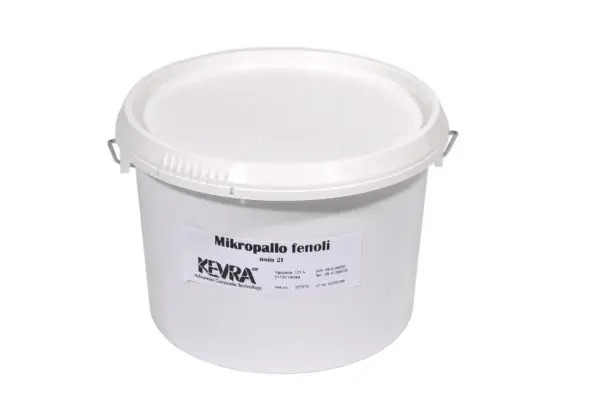
MICROBALLOONS PHENOLIC 2 L
Filler for resin systems. Cellulose microfibres are used to reinforce the resin and ensure the integrity of adhesive joints. The ground, bleached wood pulp fibres absorb resin effectively. Fibre length 200–300 µm and bulk density 0.10 g/cm³.
Working Instructions
Fillers prevent adhesive from running out of the joint, excessive absorption into the bonded materials, and the formation of resin-starved areas. Adding filler also increases the thickness of the adhesive layer.
Fillers are added to the pre-mixed resin-hardener mixture. When thickening, the amount of filler usually does not need to be measured precisely. Filler is added to the resin-hardener mix until the desired consistency or property is achieved. The accompanying table provides indicative values for the amount of filler used in different cases. The values in the table indicate how many parts by volume of filler are added to one part by volume of the resin-hardener mixture.
Filler Selection
Filler Selection | Phenolic Microballoons | Glass Microballoons | Cellulose Fiber | Silica Fume | |
Filling and Fairing | Easy to sand and ideal for cosmetic wood applications | ✓ | ✓ | ||
Filling and Fairing | General applications | ✓ | ✓ | ||
Filling and Fairing | More wear-resistant putty | ✓ | |||
Bonding | Soft wood general bonding applications, brown | ✓ | ✓ | ||
Bonding | Soft wood general bonding applications, white | ✓ | |||
Bonding | Structural wood bonding, matte | ✓ | ✓ |
Putty Mixing
FILLER | FILLER CONTENT | FILLER CONTENT | SILICA FUME | SILICA FUME | Approx. Density | Approx. Density |
% | PER 1KG | % | PER 1KG |
|
| |
Phenolic Microballoons, brown | 15 - 20 | 150 - 200 g | 3 - 5 | 30 - 50 g | 0.7 | 1.8 |
Glass Microballoons, white | 15 - 20 | 150 - 200 g | 4 - 6 | 40 - 60 g | 0.6 | 2.0 |
Cellulose Fiber, white/matte | 7 - 10 | 70 - 100 g | 2 - 4 | 20 - 40 g | 0.9 | 1.0 |